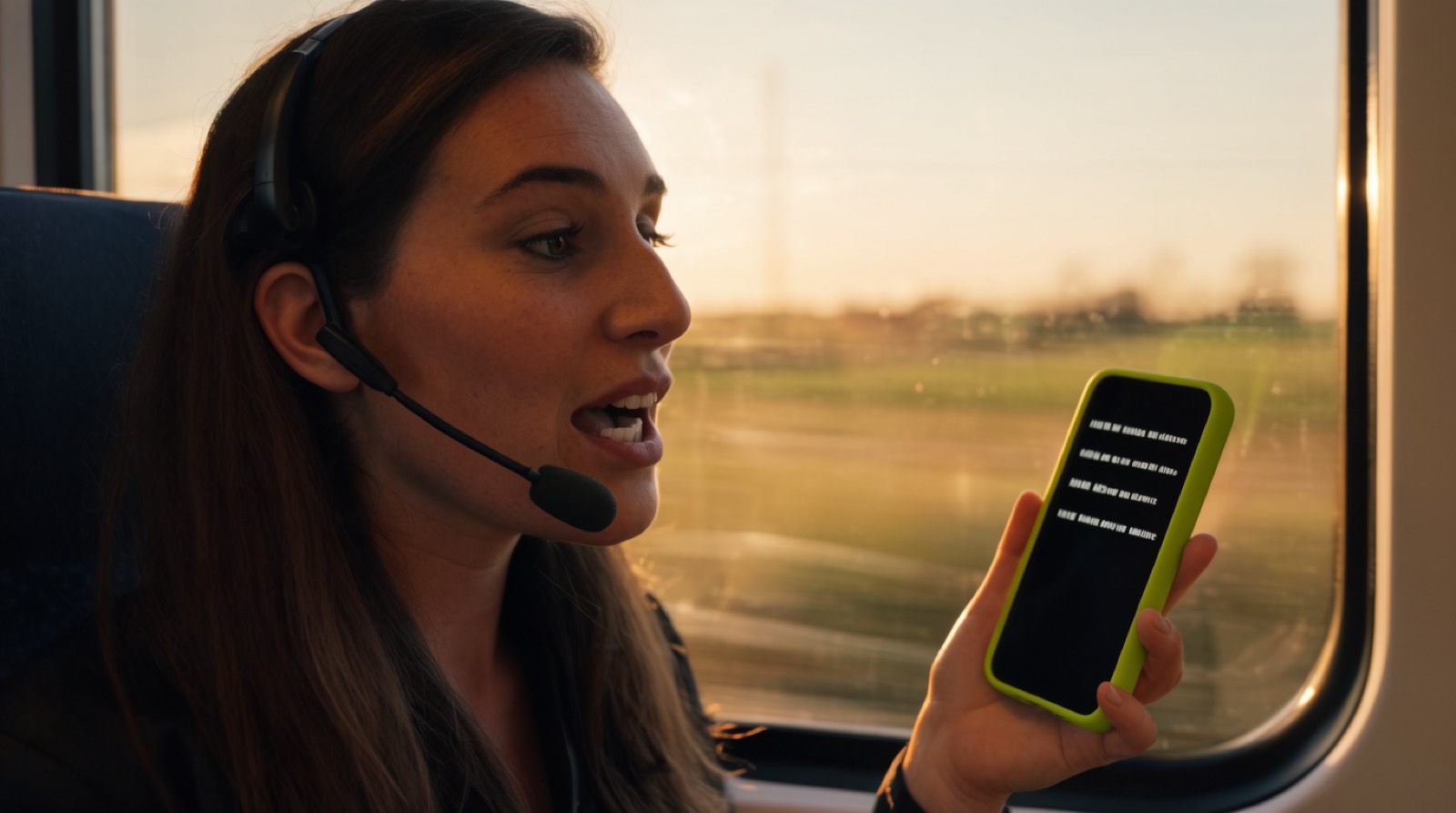
Phraseology is learned by saying it, often, until the right words arrive without being searched for. The drills put a student into a short exchange and score the run. A student who fumbles a readback runs it again, and does not have to ask anyone first.
They sit on the same platform as the theory and the exercises, behind the same login.
Why this is a practice problem
Nobody learns phraseology by reading it. The words are not difficult and the rules are written down. The difficulty is producing them under load, in the right order, while something else is demanding attention, and that is closer to a motor skill than to knowledge.
Motor skills need volume. A student who has said a clearance out loud many times over is not simply better at it than one who has said it twice. They are doing a different thing, because the second student is still composing and the first is not.
Volume is precisely what a timetable struggles to supply. An hour of group work gives each student a handful of transmissions and a great deal of listening to other people take theirs.
Why the words are fixed
Standard phraseology exists because ordinary language is ambiguous under pressure and across accents, and because the people using it are frequently not speaking their first language. Fixing the words removes the ambiguity, and fixing the order means a listener knows what is coming before it arrives.
The readback is the part that makes it a safety mechanism rather than a style guide. A clearance that is read back wrong is caught in the moment by the person who issued it, which only works if both halves of the exchange are predictable enough that a deviation stands out immediately.
All of which is a way of saying the words are not decoration and there is no personal register to fall back on. A student who improvises has not been creative, they have broken the mechanism. The only way past that is to have said the correct thing so many times that it is what comes out.
How a drill runs
A drill is short on purpose. A situation, an exchange, a score, and the option to go again. The student speaks, and nothing in the exercise is waiting for a partner to be free.
Being short is what makes the volume possible. A student with ten minutes spare does ten minutes of drills. That same student would never book a room for ten minutes, and nobody would give them one.
Where it comes from
Lektor already supplies phraseology training technology to Adacel. The work behind these drills is not new and it has been in service outside this platform for some time.
What is new is that it now sits where the students already are. No second tool, no second login and no second device: a student running a drill on a phone at a bus stop is running the drill a student at a desk is running.
What it does not replace
Drilling phraseology is not the same as using it, and nothing here pretends otherwise. The words have to hold up inside an exercise where something is going wrong and the student is thinking about six other things at once.
The drills are what makes that possible, by getting the composing out of the way first. A student who is no longer hunting for the phrase has attention spare for the traffic.
Scores on the drills go into progress data the way every other run does, per student and per drill, so a phrase an entire intake keeps stumbling over is visible as one.
More from Lektor
The ATCO Black Belt track opens.
Badges, leaderboards and a belt that has to be earned across exercises rather than won in one of them.

Practice does not keep office hours.
The T3 Simulator is open whenever the student is free, which is often not when the building is.

The Assessor refresher opens again.
It runs remotely with an instructor, and it starts when your assessor is ready rather than on a date somebody else picked.