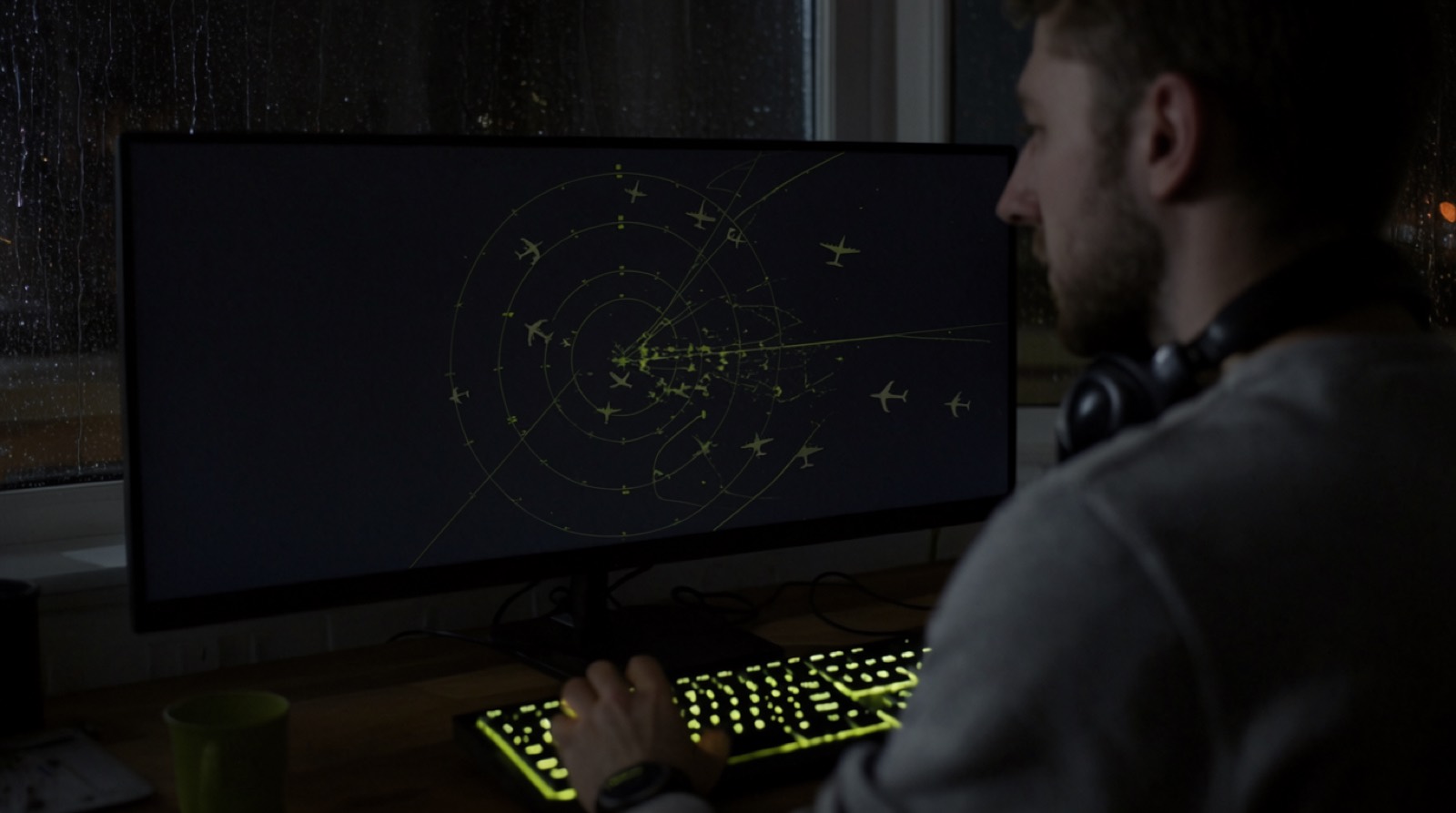
The exercises run in the browser beside the arcade set, at the point in initial training where students move from sequencing shapes to working traffic on a scope. Each run ends in a score, and the next run starts straight after it.
They are part of Lektor Takeoff Games, they open on the login students already use for the theory, and there is nothing to install.
Where they sit in the course
Takeoff Games already covered the arcade end of initial training: short games that build the habits underneath the job, sequencing, spacing, and holding a picture of where everything is and where it is going to be. Students play a lot of them and they get harder.
Surveillance control is where those habits meet a scope that looks like the job. The exercises put a student in front of traffic and ask them to work it. That step is traditionally the moment a course starts waiting for a simulator.
It does not have to be. The new set runs in the browser like everything else on the T3 Simulator, so the step happens when the student is ready to take it.
Unlimited means unlimited
None of this is booked. A student who wants to run the same piece of airspace again tonight runs it again tonight. There is no slot, no queue, and nobody to ask.
That matters more here than earlier in the course. An arcade game is short enough to repeat without thinking about it. A surveillance exercise is long enough that a student who loses the picture halfway through has to weigh up whether starting over is worth the time. When starting over is free and immediate, there is nothing to weigh up and they take the run.
Every one of those runs is recorded against the student with its score. A student who needed a great many attempts to hold the picture is not hiding that, and does not need to.
What the instructor sees
Instructors see the runs as they happened: the attempts, the scores, and the order they came in. Not a summary at the end of a block, and not a mark with the working thrown away.
The order turns out to be the useful part. Scores climbing run by run is a student learning. Scores flat across a long series of runs is a student repeating something without changing it, and that is a conversation rather than more runs.
The same attempts and scores feed the per-exercise view in Manager Tools, so the new set answers questions about the material alongside everything else on the platform.
The gap this closes
The awkward stretch in initial training has always been the one between finishing the arcade set and getting time on something that looks like the job. A student in that stretch is ready to move on and has nothing to move on to, so they go back over material they have already beaten or they wait.
Waiting is the expensive option and it is usually the one that happens, because the alternative costs a room. The cost is not only the lost weeks either. A student who has stopped progressing loses momentum, and momentum in a long course is harder to get back than it is to keep.
These exercises are what that stretch gets filled with. They are not a substitute for the room at the end of the course, and they are not pretending to be. They are the repetitions that should happen before a student walks into it.
What has not changed
The standard. Surveillance control is assessed the way it was assessed before these exercises existed, by the same people, against the same requirements. Lektor Consulting Resources Finland Oy is a (EU) 2015/340 certified training organisation, and none of that moves because the practice moved into a browser.
What changed is how much practice a student can get before anybody assesses them on it, and how much of that practice is visible to the people responsible for them.
More from Lektor
Phraseology drills come to the platform.
Standard phraseology is now practised the way everything else is, in short runs with a score at the end of each one.
The ATCO Black Belt track opens.
Badges, leaderboards and a belt that has to be earned across exercises rather than won in one of them.
Practice does not keep office hours.
The T3 Simulator is open whenever the student is free, which is often not when the building is.